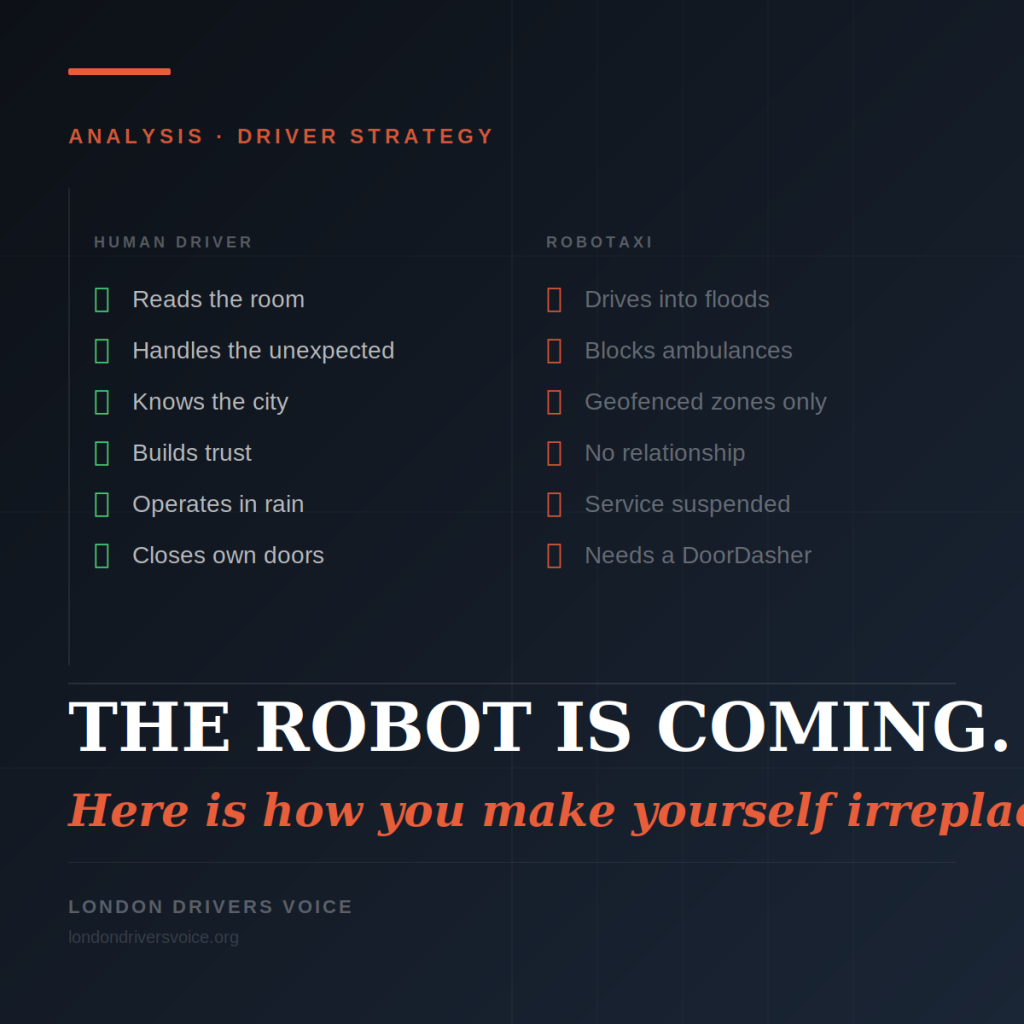
Here Is How You Make Yourself Irreplaceable.
Driverless cars will take some of your work. The question is not whether to stop them — it is whether you use the window before they arrive to build an income they cannot touch. Here is how.
London Drivers Voice · LDV Editorial · May 2026 · Analysis
Driverless cars are coming to London. Waymo has confirmed a September 2026 launch. Uber has invested in the technology and aims to be the world’s largest autonomous vehicle trip facilitator by 2029. The government has accelerated its regulatory framework. The direction of travel is not in question.
The only question that matters for London’s 110,000 licensed PHV drivers is this: when the robot arrives, what will it be unable to do? Because whatever that is — that is your business.
This is not a call for complacency. It is a call for urgency. The window to build a driverless-proof income is open now. It will not stay open indefinitely. The drivers who move first — who build the client relationships, the reputation, and the service standard that no algorithm can replicate — will be the ones who are still working profitably in five years. The ones who wait will be competing with a machine on price. That is a race no human driver can win.
The Gap That Technology Cannot Close
Autonomous vehicles are optimised for one thing: moving the average passenger from A to B in standard conditions at the lowest possible cost. They are genuinely good at this. On a dry day, on a mapped road, with a passenger who knows exactly where they are going, a robotaxi works.
But that is not what a significant proportion of your passengers actually need. And the evidence for this gap comes not from anti-technology campaigning — it comes from Uber’s own business strategy. Uber launched Uber Elite in March 2026. It acquired Blacklane — the global premium chauffeur platform — the same month. Uber is investing in autonomous vehicles for the standard market at the same time as it is paying $547 million to own the premium human-chauffeured alternative. That is not contradiction. It is market research. Uber knows that a large and growing segment of passengers will pay more for what a robot cannot provide.
| What the passenger needs | Driverless | Professional PHV driver |
|---|---|---|
| Assistance with luggage or mobility aid | Cannot help | Part of the service |
| Child or vulnerable passenger travelling alone | No supervision or accountability | Vetted, licensed, responsible |
| Passenger in medical distress mid-journey | Cannot assess or respond | Can stop, assist, call for help |
| Late-night lone female passenger | No human presence for safety | Licensed, accountable, known to TfL |
| Route change or local knowledge needed | Follows app routing rigidly | Immediate human judgment |
| Airport run with flight anxiety | No reassurance possible | Calm, experienced, reassuring |
| Elderly passenger needing patience | No adaptive communication | Human empathy and flexibility |
| Heavy rain, flooding, adverse weather | Service suspended or geofenced | Continues with appropriate care |
| Corporate client with specific requirements | No relationship, no memory | Repeat client, trusted service |
Every row in that table is a market segment. Every segment is a business opportunity. The drivers who own those segments — who are known for those services, who have built the client relationships that come from delivering them — will not be replaced by a Waymo.
What the Evidence Shows — Right Now
It would be easy to dismiss the service gap as theoretical. The evidence from Waymo’s own operational record in the US makes it concrete. This is not cited to argue that driverless technology will fail — it is cited to show precisely where the gap between algorithm and human judgment is real and documented.
Professor Jack Stilgoe of University College London told the BBC: “All self-driving car systems have limits on when and where they can operate safely. As more are deployed, more such problems are likely to emerge.” London’s streets are older, narrower, and less predictable than San Antonio’s. Its weather is wetter. Its road markings are less uniform. Its pedestrian behaviour is more complex. The gap between algorithm and London is wider than any US city.
Five Moves to Make Now
The window is open. Here is how to use it.
Five ways to build a driverless-proof income before September 2026:
Under TfL rules, all PHV bookings must go through a licensed operator. That operator does not have to be Uber. Smaller independent operators — particularly those with corporate, hospital, or school contracts — often charge lower commission and offer more consistent, higher-value work. In the short term, switching may not feel immediately more profitable. But an operator with strong corporate contracts is a shield: predictable income, repeat clients, and a relationship that cannot be disrupted by an algorithm update or a Waymo launch. Choosing the right operator is one of the most underused strategic decisions available to a London PHV driver.
Hospital discharge transfers. Accompanied school and family transfers. Elderly passenger services. Accessibility vehicles. These journeys are pre-booked through a licensed operator and are structurally immune to AV competition — they require physical assistance, adaptive communication, and human accountability. They are also higher-margin and more consistent than standard ride-hailing. Note: unaccompanied children under 16 require specific operator and vehicle conditions — confirm your operator’s terms before accepting these bookings.
A Waymo robotaxi is a commodity. A spotless, professionally presented vehicle with a consistently excellent driver is a premium product. The details matter: smooth jazz or ambient radio with an offer to change it; a water bottle on the seat; mints or chewing gum available; a USB-C and Lightning charger within reach; tissues; an umbrella for the passenger arriving in rain. Dress professionally. Keep the vehicle fragrance subtle. Greet the passenger, confirm the destination, then read the room — some want conversation, most want quiet. Warn proactively of any delays or route changes. At the end of the journey, one line: “Hope that was comfortable — if you have a moment, a rating really helps. Have a great day.” Warm, not pushy. That is what a five-star rating is made of. A Waymo cannot do any of it.
A 4.95 rating with 2,000 verified trips is a publicly audited record of professional excellence. No new entrant — human or autonomous — has that. Many operators allow passengers to request a specific driver by name. If yours does, mention it at the end of a good journey: “You can request me by name next time through [operator].” Your rating is the proof of quality that makes that request worth making. A driver with a verified record across thousands of trips is a known quantity in a market full of unknowns. That is not replaceable.
Waymo’s vehicles operate in geofenced, pre-mapped zones. They cannot take a shortcut through a road they have not been trained on. They cannot adapt to a road closure, a protest, or a flooded underpass. London’s geography — built over years of driving it — is not downloadable. It is your competitive edge. Use it.
The Demand That Goes With the Strategy
Upgrading your service is what you do for your business. But the platform conditions you work under — commission rates, algorithmic deactivation, the absence of any displacement fund — are not your fault and cannot be fixed by individual action alone. They require collective pressure on government and platforms.
The argument to make is not “ban driverless cars.” It is: “deploy them responsibly, with a transition fund for the workers they displace, a displacement impact assessment before launch, and worker protections attached to every AV licence.” That is a reasonable demand. It is supported by the evidence. And it is being ignored.
Parliament petition 751258 asks the government to respond to exactly this. It closes on 17 June 2026. It needs 10,000 signatures to force a mandatory government response. Signing it takes 60 seconds. Sharing it costs nothing. Together, those 60 seconds are the most efficient political action available to you right now.
Sign the petition — deadline 17 June 2026:
Petition 751258 demands a government response on driverless vehicle deployment and worker protections. 10,000 signatures required. Sign and share →
Read our full investigation: One Company. Every Tier. No Exit for Drivers. →