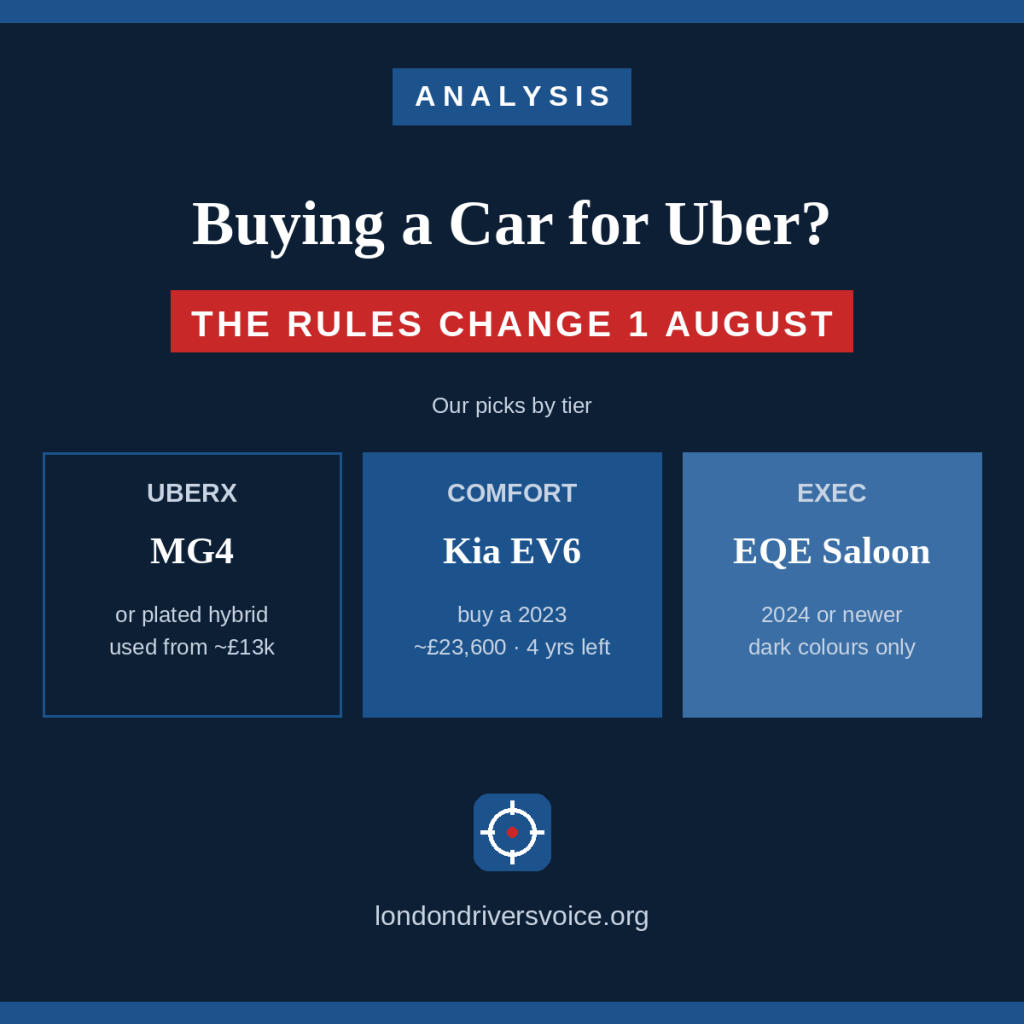
Buying a car for Uber work in London this month? Read this first: the eligibility rules change on 1 August. Any vehicle added to the platform from that date must meet Uber’s updated criteria for Comfort, Exec and Lux — and Uber’s requirements page already displays the new standards, so anyone buying now should buy to them. This guide covers what qualifies at each tier, which cars make sense, which year is the value sweet spot, and how to pay for it all. Every model named below has been checked against Uber’s eligible vehicles list for London.
The rules, tier by tier
UberX has two clocks, and Uber’s isn’t the one that matters. Uber’s London floor is a vehicle manufactured in 2008 or later — but TfL’s licensing policy caps every PHV at 10 years old at renewal, so a car simply stops being relicensable at age 10. In 2026 that makes 2017 the practical floor, and every year of vehicle age is a year of working life already spent. TfL’s other rule bites at the start: any PHV licensed for the first time must be zero-emission capable and Euro 6 — so a car being put on plate fresh must be a full EV or qualifying plug-in hybrid, while a car already carrying a PHV licence can continue to be relicensed until the 10-year cap (confirm your specific vehicle’s position with TfL before buying).
UberXL requires at least 6 passenger seats in addition to the driver, with no brand or colour rules and no Uber tier age limit — though TfL’s 10-year cap applies to XL like everything else.
Comfort and Business Comfort share one vehicle standard — Business Comfort is simply an opt-in for business-account trips. Uber’s page now lists the requirement as a vehicle no more than 6 years old in London, on a rolling basis, plus an eligible model from Uber’s published list, at least 100 trips, and a 4.85 rating. A 2020 car qualifies today and ages out first; a 2022–2023 car buys real headroom.
Exec has become a much narrower gate. Uber’s requirements now specify: brand must be Mercedes-Benz, BMW, Audi, Jaguar or Lexus; colour must be black, grey, blue, dark blue, dark grey or brown in London; the vehicle must be 5 years old or newer on a rolling basis; and saloons only — no estates, SUVs or hatchbacks. Rating of 4.85 or above. Every Exec-eligible car also qualifies for Comfort and Business Comfort, so an Exec car earns at three tiers — but the buy-in is now a nearly-new premium saloon in a dark colour, full stop.
The picks — with the money
| Tier | Pick | New (approx.) | Used (approx.) | The angle |
| UberX only | MG4 | From ~£27,000 | From ~£13,000 | Recent 0% APR deals with £1,000–£1,500 deposit contributions |
| Kia e-Niro (used) | — | Low–mid teens | 2020–21 cars carry 4–5 licensed years under TfL’s 10-year cap | |
| UberXL | Kia Sorento PHEV | From £43,725 | 2021 ~£26,000; 2022 ~£33,500 | Also Comfort-eligible — XL + Comfort from one car; 2022 buys 3 Comfort years |
| Toyota Prius+ (plated) | — | ~£12–16,000 | 2019–21 only; TfL’s 10-year cap limits older cars | |
| Comfort / Business Comfort | Kia EV6 | From £45,635 | From ~£16,500; 2022–23 ~£23,000 | Kia has run £1,500 PCP deposit contributions at 3.9% APR; 7-yr warranty transfers on used |
| Tesla Model 3 | From £37,990 | Under £30,000; 2022 cars well below | Best-in-class resale (~71% after 3 yrs) cuts true cost of ownership | |
| Exec | Mercedes EQE saloon | £70,000+ list | Early cars heavily depreciated — check 2024–25 listings | Mercedes has offered £6,000+ PCP deposit contributions on new EQE |
| BMW i5 / 530e | i5 premium-priced | 530e (PHEV) is the used-market route in | 530e keeps Exec eligibility at a fraction of EV cost — watch the 5-yr rolling limit |
All picks assume a dark colour, saloon body for Exec, and the model-year floors shown on Uber’s eligible vehicle list.
UberX only: minimum outlay, maximum margin
If you’re running UberX economics, the car is a cost centre — the job is minimising the pounds per mile it eats per licensed year remaining. The strongest new-car value play is the MG4: recent deals have included 0% APR with deposit contributions, home charging costs a fraction of petrol, and a full EV takes the reduced £13.50 Congestion Charge and unlocks electric-only trip products, which pay a premium over UberX. Used, the pick is a Kia e-Niro — PCO-ready examples trade in the low-to-mid teens with the ~280-mile real-world range covering a full shift, and a 2020–21 car still has four to five licensed years left. An already-plated used hybrid remains the cheapest entry, but count the clock before counting the saving: a 2018 Prius at £9,000 has roughly two licensed years left — £4,500 per working year — while a £14,000 2021 e-Niro has five, at £2,800 a year. The older car is the false economy.
UberXL: the seven-seater route
XL is the overlooked earner. Uber’s requirements are loose — at least 6 passenger seats in addition to the driver, no brand or colour rules, no tier age limit — but TfL’s 10-year relicensing cap applies to XL like everything else, so the year still matters. The economics are different from UberX: higher fares per trip, steady airport and group work, but a bigger, thirstier vehicle and fewer trip requests. XL suits drivers who build their pattern around airports and pre-booked group work rather than city volume.
The picks: the Kia Sorento PHEV is the default choice of London’s XL fleet — 35–43 miles of electric range covers city legs, the petrol engine handles the M25, and as a plug-in hybrid it clears the ZEC requirement for first-time licensing. And Uber’s London list reveals its real advantage: the Sorento is also Comfort-eligible (2020 onwards), making it the most versatile car in this guide — UberX, UberXL, Comfort and Business Comfort from one seat. That reshapes the year question: a 2021 at around £26,000 has five licensed years but only a year or so left inside Comfort’s rolling 6-year window, while a £33,500 2022 carries roughly three Comfort years on top of its XL life. If you’ll work the Comfort tier, the 2022 is the buy; if you’re purely an XL driver, the 2021 still wins on price. The budget route remains a used, already-plated Toyota Prius+, viable only where the plate history allows relicensing — prefer 2019–2021 and treat anything older as a short-term tool.
And the premium group tier is open after all: Exec XXL requires a high-end people carrier, and Uber’s London list shows exactly one realistic new-purchase route — the electric Mercedes EQV, eligible for Exec XXL (2019 model year onwards) and for UberXL and electric products besides. As a full EV it clears the ZEC rule for first-time licensing, where the diesel V-Class cannot. The caveats: Exec XXL carries a 6-year London age limit, so buy 2021 or newer with the same cost-per-eligible-year arithmetic as Comfort — and an EQV is serious money, so the vehicle needs consistent premium group work to justify it. No seven-seat SUV qualifies for XXL: the Sorento’s premium ceiling is Comfort.
Comfort / Business Comfort: the sweet spot
Comfort is the earnings upgrade with the smallest cost step, and Business Comfort adds corporate work on the same car for nothing. The default pick is the Kia EV6 — consistently the most recommended Comfort car among London drivers, with manufacturer PCP support (recent offers included a £1,500 deposit contribution at 3.9% APR — offers run in quarterly windows, so check what’s current) and a 7-year warranty that matters enormously at PHV mileage. The Hyundai Ioniq 5 is the same platform with more cabin space. The alternative logic is a Tesla Model 3: it holds roughly 71% of its value after three years — the best of any mainstream EV — which transforms total cost of ownership even when the monthly looks higher. With the 6-year London limit now in force for new additions, buy 2021 or newer at minimum; 2022–2023 used examples are the value zone, often 40% below list.
Exec: five brands, dark colours, saloons only
Under the new criteria, an Exec purchase means one thing: a Mercedes, BMW, Audi, Jaguar or Lexus saloon, dark-coloured, under 5 years old. For a car being newly licensed, the ZEC requirement narrows it further to electric or plug-in hybrid versions. That points to the Mercedes EQE saloon (Mercedes has recently offered £6,000+ deposit contributions), the BMW i5, or — the lower-cost PHEV route — a BMW 530e. All three are Exec-eligible on Uber’s London list from model year 2021. The traps to avoid: any SUV or estate (excluded outright), any colour outside the approved list (a white EQE is a Comfort car at Exec money), and any vehicle already 3+ years old, which may have under two years of Exec eligibility left before the rolling 5-year limit catches it. And the arithmetic must work: an Exec car costs roughly double a Comfort car to buy, insure, and depreciate, so it needs to be busy at Exec rates. If demand in your working pattern is uncertain, Comfort is the lower-risk step.
New or used?
New buys warranty, the longest runway before rolling age limits catch up, and manufacturer finance support. Used buys a much smaller debt — and EV depreciation has been steep enough that two-year-old Comfort-eligible cars often cost 40% less than new. The rule of thumb: the higher the tier, the stronger the case for newer, because the age limits are tighter — 6 years for Comfort, 5 for Exec, both rolling, with TfL’s 10-year cap underneath everything. For UberX, used wins almost every time. For Exec, buy as close to new as the finances allow, because every year of age is a year of premium eligibility you’ve paid for and can’t use.
Which year to buy — tier by tier
UberX: the 10-year TfL cap is the clock. There’s no Uber tier limit to worry about, but TfL stops relicensing any PHV at 10 years old — so divide the price by the licensed years remaining, exactly as with Comfort. The sweet spot is 2020–2021: most of the depreciation absorbed, four to five working years left. Anything 2018 or older is cheap for a reason, and a 2017 car bought today is a one-year car whatever the price. The same logic applies to UberXL — unless you want the Sorento’s Comfort eligibility, where the 6-year window makes 2022 the play.
Comfort: buy a 2023. The rolling 6-year London limit gives each model year a fixed amount of Comfort earning life, and EV depreciation is front-loaded, so the middle years are where the value sits. On a Kia EV6: a 2023 at roughly £23,600 has about four years of Comfort eligibility left — around £5,900 per earning year. A 2022 costs £600 less but loses a whole year (£7,700/year). A 2021 runs £9,500/year, and a 2020 — Comfort-priced at £16,500 with barely a year left before it drops to UberX-only — is the trap to avoid. A 2024 is a rational stretch at £3–4,000 more for another year; a new car costs double a 2023 for two extra years and hands you the steepest depreciation.
Exec: buy 2024 or newer — or don’t buy. The 5-year rolling limit compresses everything. A 2022 Exec car has roughly one year of Exec eligibility left; a 2023, two. However cheap a heavily depreciated 2022 EQE looks, its price per Exec-earning year is worse than a newer car’s, and when it ages out it becomes a Comfort car you overpaid for. The used sweet spot is 2024–2025 — most of the depreciation absorbed by the first owner, three to four years of Exec life remaining. If the numbers only work with a 2022–2023 car, the honest conclusion is that Exec doesn’t work for you yet; buy the Comfort car instead.
Financing the sweet-spot car
Take the 2023 EV6 at £23,600 as the worked example. On hire purchase with £2,500 down, borrowing £21,100 over four years at a typical used-car rate of around 9–10% APR, expect roughly £520–£540 a month — with no mileage cap, and the car is yours at the end with UberX-eligible resale value still in it. On PCP the advertised monthly will look £100–150 lower, but the quote will assume 8,000–10,000 miles a year; re-quoted at a realistic 25,000–30,000, the balloon shrinks, the monthly rises, and the gap largely disappears — while the mileage cap risk stays yours. PCP only clearly wins on new cars carrying manufacturer support: 0% APR and deposit contributions (as MG has run on the MG4, Kia on the EV6, and Mercedes on the EQE) are subsidies you can’t get on the used market, which is part of why a new MG4 can undercut financing an older, pricier car. Leasing has the same mileage problem plus no asset at the end. Rent-to-buy and flexi-rent through PCO fleets costs the most in cash terms — Comfort-class EV packages typically run several hundred pounds a week — but bundles insurance and maintenance, and some fleets have negotiated grandfathering deals that protect their vehicles’ tier eligibility for years — protection no private buyer gets. If you’re not certain about the trade, renting first is the cheapest way to be wrong. Uber also lists partner offers, including co-funded EV programmes, on its Vehicle Marketplace — worth checking before you finance elsewhere. We’ll compare the PCO fleet suppliers in detail in a separate piece.
Monthly figures are illustrative, based on typical market rates in July 2026 — your quote depends on credit profile, deposit, and term. Always compare the total amount payable, not the monthly, and check current manufacturer offers before assuming a deal is still running.
The other side of the ledger: will the tier pay for the car?
Everything above is cost. The decision needs the earnings side, and here honesty is required: Uber does not publish fixed fare multipliers for Comfort or Exec, rates vary by time and demand, and your uplift depends on how many of your trips actually come through the higher tier. So run the break-even instead. Using the worked examples above: the 2023 EV6 on HP costs roughly £540 a month against perhaps £250 a month financing a UberX-only car — a gap of about £290 a month, or £67 a week. If Comfort and Business Comfort trips add less than that to your weekly take, the upgrade loses money regardless of how good the deal on the car was. Check your own trip history: if you already drive a Comfort-eligible car, the app shows you what share of work comes through the tier. If you don’t, ask drivers on your circuit — not the fleet trying to rent you the upgrade.
Charging access can decide the whole question. An EV charged at home overnight costs a few pence per mile — the cheapest fuel any PHV driver has ever had. The same EV fuelled on public rapid chargers can cost close to what petrol does. If you have a driveway or reliable overnight charging, every EV pick in this guide gets stronger. If you don’t, be realistic about where and when you’ll charge before committing to any of them — and note that a plated hybrid, which this guide lists as the budget UberX route, dodges the problem entirely.
Insure before you sign, not after. PHV insurance on a newer, higher-value, high-insurance-group EV can cost substantially more than on the hybrid it replaces — sometimes by enough to consume the tier uplift on its own. Get an actual quote on the specific car, your postcode, and your claims history before you commit to the purchase; a £1,000-a-year premium difference is £83 a month straight off the break-even. And a final line for the accountant rather than the forecourt: the tax treatment of buying, financing, and running a vehicle differs by method and by whether the car is new or used — worth a conversation before you choose the finance route, not after.
The verdict
Every car on London’s PHV market is a depreciating licence with a countdown — Uber sets the clock at the top tiers, TfL’s 10-year cap sets it everywhere else, and the buying skill is paying the least per year left on it. For most drivers weighing this decision in July 2026, that logic lands on a used 2023 Comfort-eligible EV on hire purchase: Comfort and Business Comfort earnings on a manageable debt, no mileage anxiety, four years on the tier clock, and an asset at the end.
The year that wins on price: 2023. EV depreciation is front-loaded, so a 2023 Comfort car costs almost the same as a 2022 — around £600 more on a Kia EV6 — but carries an extra year of eligibility under the rolling 6-year rule: roughly £5,900 per year of Comfort earning life, against £7,700 for a 2022 and £16,500 for a 2020 car with barely a year left. Buy it in a dark colour — it costs nothing at purchase and keeps the Exec door open if you later trade up within the five brands. Above all, re-check the exact make, model, and year against Uber’s eligible vehicle list before signing anything: Uber states plainly that it can amend its requirements and accepted vehicles at any time, at its sole discretion. The 1 August change is simply the latest proof. Buy the car that survives the rule changes, not just the one that qualifies today.
All tier eligibilities for the models named were checked against Uber’s eligible vehicles tool for London in July 2026: EV6, Ioniq 5 and Model 3 are Comfort-eligible from model year 2020; EQE, i5 and 530e are Exec-eligible from 2021 (and Comfort from 2020); e-Niro and MG4 are UberX/Electric; the Sorento is UberXL- and Comfort-eligible; the EQV is Exec XXL-eligible from 2019. Eligibility criteria are taken from Uber’s UK vehicle requirements page and 1 August update announcement, and TfL’s Taxi and Private Hire Vehicle Policy, as of publication; finance offers and prices change frequently. Uber can amend its requirements and accepted vehicles at any time, so re-check before signing — if a qualifying model isn’t yet on the list, Uber requires a form submission that can take up to four weeks to process, so time your purchase accordingly. Verify licensing questions with TfL directly. This article is general information, not financial advice.