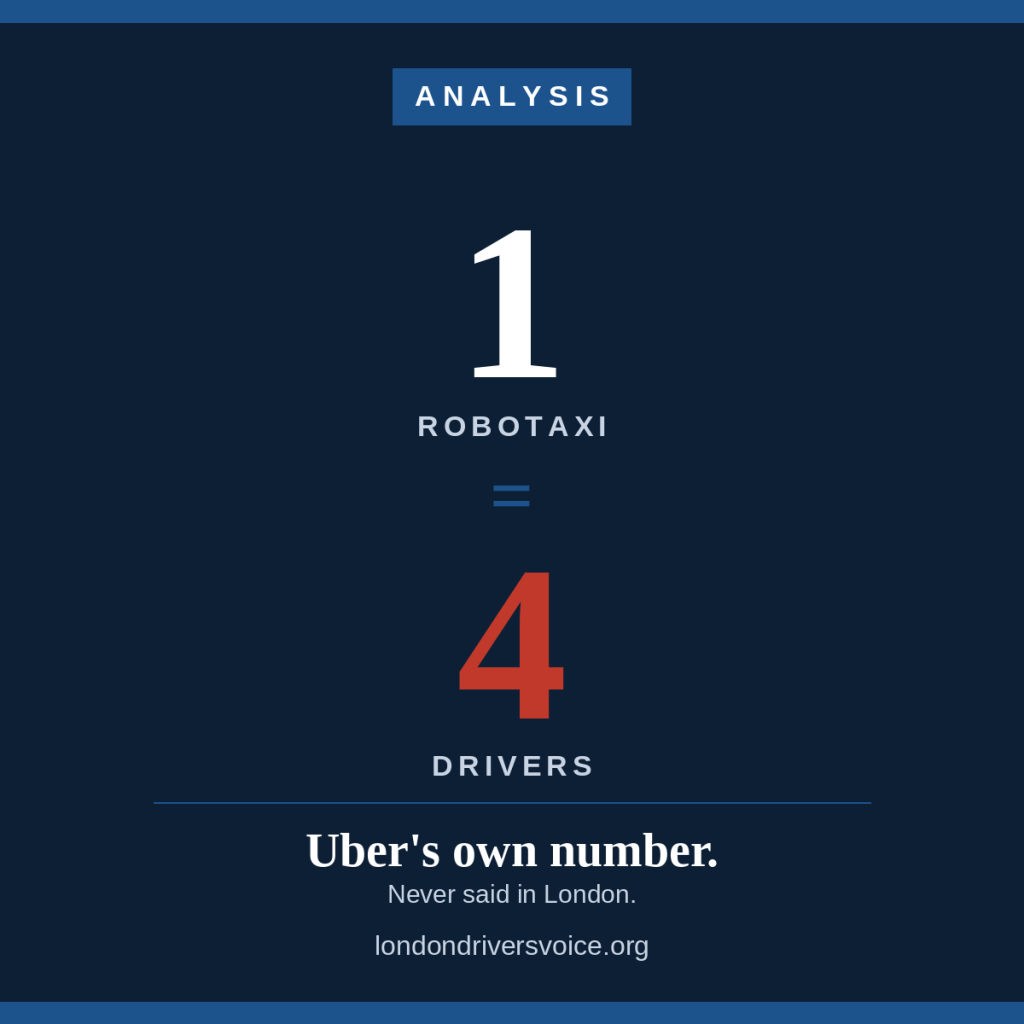
One robotaxi does the work of about four drivers. That is not a fear from a picket line or a union leaflet — it is Uber’s own number, from Uber’s own policy paper, shared with regulators in Washington, D.C. this year. Uber told American officials plainly that autonomous vehicles will displace human drivers, and lobbied for a rule requiring robotaxis to share ride-hailing platforms with human drivers rather than operate alone. This week, autonomous vehicles began road testing on London’s streets — Baidu’s Apollo Go robotaxis, running through both Uber’s and Lyft’s platforms, in the borough of Brent. London has not heard a word of what Uber told Washington.
What Uber told Washington
In May, Uber shared a 15-page policy paper, Unlocking the Promise of Autonomy, exclusively with Axios. It is unusually direct for a corporate policy document. Uber concedes that autonomous vehicles could mean less work for drivers over the long run, and offers a headline finding, presented in the paper as a standalone statistic: “In California, one AV does the work of about four drivers.” The paper states that in many cities drivers will face fewer or different trip opportunities over time, and that acknowledging this is a necessary starting point for handling the transition responsibly. It also warns of a second risk: that autonomy left to pure market forces will concentrate in wealthier areas, recreating what the paper itself calls a two-tier transportation system in which access depends on postcode.
Uber’s proposed fix is a “hybrid network” — a regulatory requirement that robotaxis operate on the same ride-hailing platform as human drivers, rather than as a standalone AV-only service. The company is lobbying for exactly this in Washington, opposing elements of a D.C. Council bill that would allow robotaxi operators to run driverless fleets under a 200-vehicle cap and a 15-cents-per-mile fee. Uber’s U.S. policy chief, Javi Correoso, told the Council the alternative would functionally hand the market to Waymo, telling TechCrunch directly that “consumers [should] be able to take an Uber that’s driven by a human.” Uber’s director of AV and AI policy, Harry Hartfield, was blunter still with Axios about why the company is volunteering this now: “if we are not engaging on what we know are the tough issues,” he said, Uber will not succeed in major markets — naming Chicago, Boston and New York — pointing to a US legislative stalemate in which AV bills have stalled in at least eight states and no federal law has passed in five years.
What Uber has told London: nothing
London has more riding on this question than almost any market Uber operates in. TfL holds licensing authority over any commercial passenger service. London has roughly 110,000 licensed PHV drivers — a workforce whose displacement risk Uber has now quantified, in writing, for its own regulators in California and Washington.
Nor can London be dismissed as a minor market Uber has not gotten around to. In materials shared with investors, Uber itself described its planned London trials as “the largest market where Uber has announced an intention to pilot autonomous vehicles” — its own words, about its own largest AV commitment anywhere.
Uber has not been silent about autonomous vehicles in London — it has been enthusiastic. Announcing its robotaxi partnership, Uber said it was “excited to accelerate Britain’s leadership in the future of mobility, bringing another safe and reliable travel option to Londoners.” That is Uber’s register for London: excitement, opportunity, leadership. It is a different register entirely from “we owe people the truth” and “one AV does the work of about four drivers” — the language Uber uses for the same technology in its own policy paper for US regulators. Uber has made no public statement to TfL, the UK government, or London’s drivers containing any part of that second register. No displacement figure for London. No hybrid-network advocacy put to TfL. No acknowledgment, in the market where it is actively deploying robotaxis, that drivers here might face fewer or different trip opportunities as a result.
Uber’s own president and chief operating officer, Andrew Macdonald, may have inadvertently explained why. Promoting the white paper on LinkedIn, he wrote that public trust in AVs lags because hard questions get sidestepped, and traced that pattern back to Uber’s own history — admitting the company’s past mistakes brought “regulatory battles and a corporate crisis that damaged trust for years.” Macdonald did not name a market. But it is difficult to read that line in London without thinking of Transport for London’s decision to strip Uber of its operating licence, twice, over safety and reporting failures — arguably the most damaging regulatory battle Uber has faced anywhere. If that experience is part of what changed Uber’s approach, as Macdonald suggests, London has more claim than most cities to the candour Uber is currently extending to Washington.
The robots arrived this week
This is no longer a future scenario. On Tuesday, Baidu’s Apollo Go robotaxis began road testing on London’s streets for the first time — RT6 vehicles, with safety operators on board, running in Brent, a mix of urban and suburban roads. The deployment runs through two separate deals: Uber signed a multi-year global partnership with Baidu in July 2025, while Lyft signed its own European agreement with Baidu the following month, specifically targeting the UK. Lyft now owns FreeNow, the taxi and PHV app used by many London drivers, having bought it from BMW and Mercedes-Benz for around $197 million — so the Baidu vehicles now testing on London’s roads reach passengers through FreeNow’s own booking platform. Public rides are not expected until 2027, subject to regulatory approval. Waymo’s roughly 100-vehicle test fleet is a separate effort again, running independently of both Uber and Lyft.
That means three distinct autonomous vehicle pushes are now active or imminent in London — Waymo’s own fleet, Baidu vehicles reaching riders through Uber, and Baidu vehicles reaching riders through Lyft’s FreeNow — at exactly the moment TfL has told LDV it holds no projection of how many driver jobs are at stake and considers it “too early” to estimate how many AV licences it expects to issue. Uber’s own promotional language for this deployment was that it is “excited to accelerate Britain’s leadership in the future of mobility.” Its own white paper’s language for the same technology, aimed at US regulators, was that “some drivers will inevitably be displaced.” London has had the excitement. It has not had the honesty.
There is a further wrinkle worth naming plainly. Uber and Lyft compete fiercely for passengers and drivers everywhere else. In London’s robotaxi rollout, both are running the same underlying Chinese autonomous vehicle technology from the same supplier. The rivalry that matters to Uber, on its own account, is not with Baidu, or even primarily with Lyft — it is with Waymo, the one major operator trying to own its own robotaxi service outright rather than distribute through a platform like Uber’s.
The airport question, again
Where Waymo is actually pointing its London operation adds a sharper edge to this. Alongside a base of operations established in west London, reporting indicates the company has been conducting market research specifically on airport pickups — one of the most lucrative segments of London’s taxi and PHV market, and the subject of LDV’s own reporting on how much of a driver’s income depends on it. A robotaxi service targeting exactly the routes that currently sustain a meaningful share of PHV driver earnings is not a hypothetical future risk. It is the plan, as far as it has been reported, and it is a live illustration of the “two-tier,” geography-driven displacement Uber’s own white paper warns regulators about.
A question TfL’s own paperwork doesn’t ask
TfL’s published position on automated vehicles sets out five priorities for how AVs should be introduced: road safety, network efficiency, accessibility, air quality, and data security. Driver employment is not among them. The London Assembly’s Transport Committee has opened a fresh investigation, within the past fortnight, that explicitly puts the employment question TfL’s own paper omits back on the table — including impact on “the taxi and wider private hire vehicle sectors.” It is, in effect, the same question the House of Commons Transport Committee raised nationally in 2023, when it concluded that “not enough attention has been paid to the impact of AVs on human drivers” — a finding that predates Uber’s own white paper by nearly three years.
The black cab trade has, at least once on record, sounded less concerned than might be expected. In June 2025, an LTDA spokesperson told the trade press there was “no chance” of robotaxis encroaching on black cab work, citing passenger preference for human drivers. That was before Waymo established an operational base in west London and before this week’s Baidu road tests began. Whether that confidence holds a year on is one of the questions LDV put to LTDA for this piece; LTDA did not respond by publication.
The pattern held again the day before this article’s own deadline. Asked by the Local Democracy Reporting Service about the AV rollout generally, TfL’s response ran to several paragraphs — citing the Automated Vehicles Act 2024, the Mayor’s Transport Strategy, congestion management, and Vision Zero’s target of eliminating road deaths by 2041 — without once addressing the “concerns in London about job losses among taxi and private hire drivers” the same report noted exist. The Standard did not ask TfL about driver displacement specifically — its questions were about congestion, safety, and legislation. So it isn’t that TfL was asked and dodged the question; the question wasn’t on the table. LDV’s own questions to TfL, sent that same week, asked about displacement directly. TfL’s fuller answer is below.
Who’s even in charge is still being decided
Adding to the uncertainty: it is not yet settled who holds the licensing power that would make any of this real. Caroline Russell AM, who chairs the London Assembly Transport Committee, has said the Department for Transport has effectively “stepped in on London’s devolved powers,” with ministers controlling robotaxi trials and granting permissions without TfL having a formal say. TfL’s own commissioner, Andy Lord, warned the committee in March of a “risk” that the DfT could end up with greater regulatory control over autonomous vehicles than TfL itself — precisely the kind of gap in which a question like driver displacement can go unanswered by everyone, because no single body is yet confirmed as the one who has to answer it.
There is also, on TfL’s own telling, a gap in what needs its permission at all. TfL has confirmed it holds the power to block firms from running commercial passenger services without a licence — but companies could seek approval for autonomous shopping or food delivery services on London’s roads without TfL sign-off. Whatever the merits of that distinction for logistics, it means the regulatory net Uber, Waymo and Baidu’s partners are navigating in London is looser, and less settled, than the one Uber is lobbying so precisely over in Washington.
What TfL told LDV directly
Asked generally by the Standard the day before, TfL’s public statement omitted driver jobs entirely. Asked directly by LDV, TfL did engage: a spokesperson said the organisation is “aware of the risks which any AV technology could have on jobs, particularly drivers and other employees in the PHV and taxi trade,” and pointed to its TPH Action Plan 2025, which it says focuses on supporting drivers through change. TfL confirmed it is in active discussions with Uber and Wayve about trialling AV-featured vehicles with a driver still present and responsible for the vehicle at all times — meaning no fully driverless commercial PHV service is currently on the table in London under that specific route, even as Baidu’s robotaxis test on public roads under a different regulatory pathway.
But asked the two questions that would give that reassurance some substance, TfL’s answers were plainer. Does it hold a projection of licensed PHV driver numbers over the next five years? “We do not hold future projections for PHV driver volumes” over that period, a spokesperson said. How many AV operating licences does it expect to issue over the same period? TfL said it is “too early to make firm predictions” and cannot comment on the volume of applications it expects.
Put side by side with Washington, the comparison is stark. Uber’s own white paper offers regulators a number — one AV displacing roughly four drivers — and a proposed mechanism, a mandatory hybrid network. Asked the equivalent question directly, London’s regulator has neither. TfL is not refusing to engage with driver displacement. It is engaging with it, and revealing that it currently has no data with which to measure the scale of what it is regulating.
What GMB told LDV
GMB’s response sharpens the point further. The union told LDV it has passed internal motions opposing AV deployment, that GMB London has led on this with TfL directly, and that it has made direct representations to the Department for Transport arguing there is no evidence anywhere that any AV operator, or city, has adopted measures to support drivers through the transition — a direct challenge to the premise of Uber’s own white paper, which points to Austin, Atlanta and Phoenix as evidence that a hybrid model can keep driver earnings stable. GMB’s assessment is that nowhere, including those cities, has anything resembling a real driver-support framework actually been put in place.
GMB also anticipates the pattern LDV has reported separately: asked about how AV operators are likely to behave, the union said it would not be surprised to see operators target the most lucrative trips first, noting this “has been the model elsewhere.” That is a close match, from a source with no visibility into Waymo’s own plans, for what reporting indicates Waymo is already doing in London: an operational base in west London and specific research into airport pickups, one of the most valuable segments of the market.
Not just Uber’s argument to make
It would be easy to dismiss Uber’s displacement argument as competitive positioning dressed up as principle — and the self-interest section above shows there is real substance to that read. But the underlying concern is not manufactured by Uber alone. In Washington, a Teamsters local opposing the same D.C. bill argued, independent of Uber’s lobbying, that the legislation risks “trying to steamroll cities into changing laws to accommodate them,” at the expense of professional drivers. Unions with no commercial stake in Uber’s marketplace position are making a version of the same argument Uber is now making for itself.
What London’s unions are already asking for
ADCU did not wait to be asked twice. Responding to LDV’s query, an ADCU spokesperson set out three demands: a full economic impact assessment of driver displacement — jobs at risk, lost earnings, and the consequences for the London economy and HMRC receipts, which ADCU itself estimates at £3.3 billion a year in lost driver earnings; a legally enforceable “Just Transition” framework covering retraining, income protection and pathways into alternative employment, negotiated with trade unions rather than imposed; and, in the meantime, an immediate pause on any expansion of autonomous vehicle trials until that assessment and that framework exist.
That is a more demanding position than Uber’s own white paper takes. Uber argues for a phased, hybrid transition that slows displacement without stopping it. ADCU is asking for deployment to stop until the costs are measured and a framework is in place to meet them. Whether TfL, the Assembly, or Uber itself engages with a £3.3 billion figure — a number nobody in this debate has yet publicly disputed — will say a great deal about how seriously London’s regulators are treating a question Uber has already answered, in writing, for Washington.
What London’s drivers and TfL are entitled to ask
Uber’s own paper argues that a rapid, AV-only transition risks uprooting drivers, while a phased, hybrid approach preserves work and gives drivers time to adapt. If Uber believes that case is strong enough to fight for in Washington — strong enough to commit to a 15-page public document and testimony under oath — London’s drivers, GMB, ADCU, LTDA, and TfL itself are entitled to ask why Uber has not made it here, and whether Uber will commit, in writing, to advocating the same protections for London that it is currently lobbying for in D.C. Robotaxis are no longer a question of if. They are being road-tested this week, a few miles from where many of London’s 110,000 PHV drivers are working right now.
What happens next
LDV contacted Uber and Waymo on 21 July; GMB, ADCU and LTDA the same day; TfL on 24 July; and the London Assembly Transport Committee on 21 and 25 July, with a deadline of Tuesday 28 July, 17:00 BST. ADCU responded on 23 July, GMB on 27 July, and TfL on 28 July — all quoted in full above. Waymo, LTDA, and the Transport Committee did not respond by the deadline. Uber did not respond by the deadline, including to LDV’s direct question about whether its own “one AV for four drivers” figure applies to London — its fifth consecutive right-of-reply request from LDV to go unanswered since May 2026. This article will be updated with any response received, in line with our right-of-reply policy.
This article draws on Uber’s policy white paper “Unlocking the Promise of Autonomy” (May 2026); reporting by Axios, TechCrunch, Electrek, CNBC, TechNode, CnEVPost, London Centric and the Local Democracy Reporting Service; testimony to the Washington, D.C. Council in July 2026; and “Driverless cars in London” (London Assembly Research Unit, January 2026). Direct quotations are reproduced under fair dealing for the purposes of reporting and criticism. Displacement dynamics, regulatory frameworks and market structures differ between California, Washington D.C. and London; this article compares the public positions taken in each, not the underlying markets themselves.