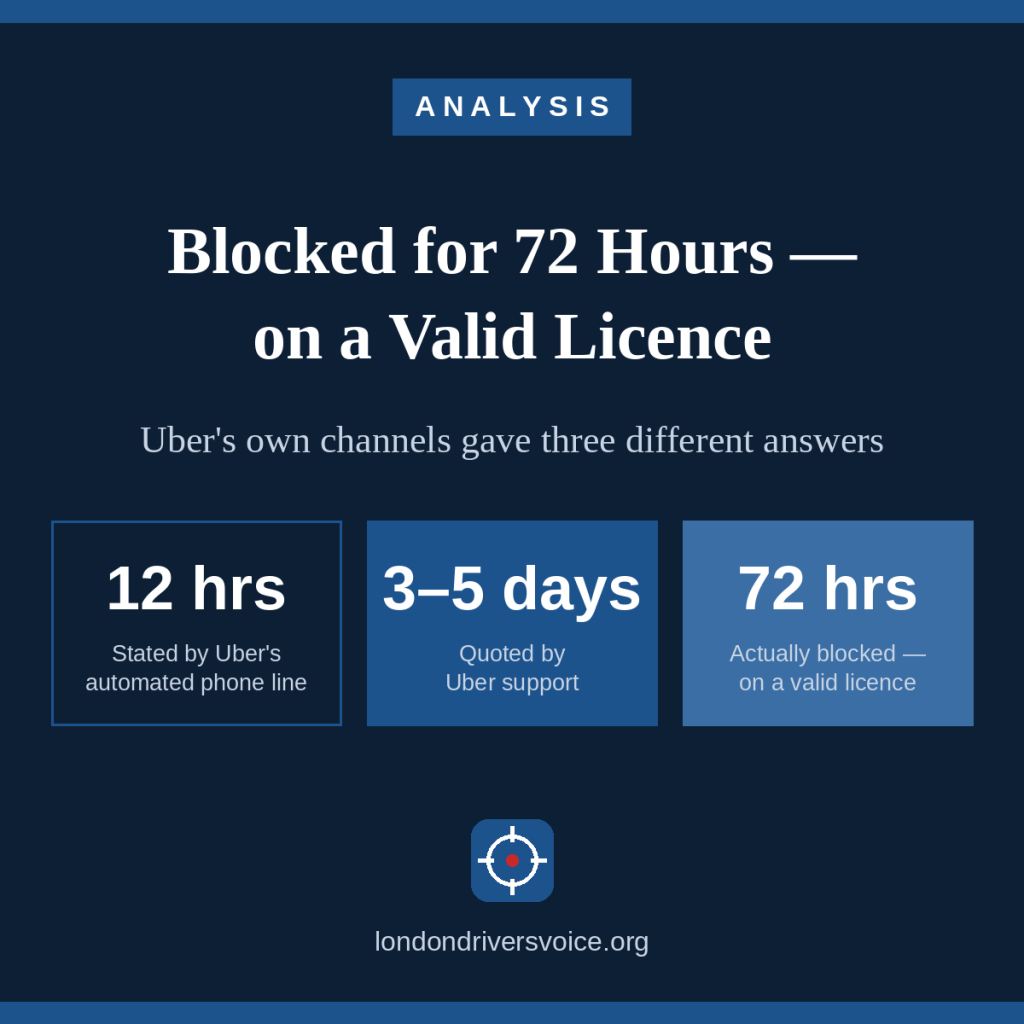
My DVLA driving licence was valid until 27 July. I renewed it early — the responsible thing to do — and uploaded the new licence to Uber last week, well before the old one expired, because Uber is normally quick to approve documents. Its automated customer service phone line states that document reviews take 12 hours.
Instead, the moment I uploaded the renewed licence, Uber blocked my account. A driver holding a valid licence — with more than two weeks still to run on it — was locked out of work not because a document had expired, but because he had submitted its replacement early.
The next day, a message from Uber support quoted a review window of three to five business days. The message — a templated response, complete with one blank bullet point where text should be — read in part:
“Your document is currently pending review, and we’re experiencing higher than usual review volumes at the moment. This means the review may take longer than expected… This can take 3-5 business days.”
The licence was submitted on Thursday 9 July and approved on Sunday 12 July. That is roughly 72 hours blocked from working — six times longer than the 12 hours Uber’s own phone line promises, while holding a licence that was valid for every one of those hours. With no route to anyone at Uber who could say more, I turned to GMB — of which I am a member — for help while the document sat in review.
|
12 hrs
Review time stated by Uber’s automated phone line
|
3–5 days
Review window quoted by Uber support
|
72 hrs
Blocked from working — on a valid licence
|
A block that punishes compliance
For PHV drivers, document review isn’t a formality. Licence renewals, insurance updates, and right-to-work checks sit behind this process, and a driver whose documents are “pending” can be blocked from the app while Uber decides. What this case shows is that the block is applied even when there is nothing to decide: the existing DVLA driving licence on file was valid throughout — the renewal was submitted more than two weeks before it expired. Nothing about the driver’s legal entitlement to drive changed at any point.
The perverse incentive is obvious. A driver who uploads a renewed document early, as good practice, triggers an immediate block and loses days of earnings. A driver who waits until the last moment risks the same block landing exactly when the old document expires. Either way, the driver pays for the length of Uber’s queue — and Uber’s own channels can’t agree on how long that queue is.
Is this just me?
Uber’s own message concedes “higher than usual review volumes,” which is itself an admission that something has changed. What it doesn’t say is why, for how long, or which figure a driver should believe.
It isn’t even the first time for this driver. An insurance document I submitted earlier went through the same pattern — a review that took longer than usual, with the same silence about why. Two documents, two delays, no explanation either time.
Driver forums have carried versions of this complaint for years — threads on uberpeople.net describe re-uploads that once cleared in under an hour stretching into multi-day waits, with drivers speculating about processing backlogs. Those threads aren’t recent data and aren’t proof of a current, London-specific surge — they’re a pattern of the same complaint recurring over time. Taken together with Uber’s own acknowledgement last week, it’s reasonable to treat this as more than an isolated glitch, even though LDV does not yet have the volume of driver reports needed to call it a confirmed systemic backlog.
Counterproductive — even for Uber
Here’s what makes the block hard to explain even on Uber’s own terms: every hour a driver is blocked is an hour Uber earns no commission from that driver. And blocked drivers don’t simply wait. During those 72 hours I did what any driver with bills to pay does — I switched on Bolt and FreeNow.
I had been hesitant about both apps for a long time. If Uber had been working, I would never have turned them on. Three days later, I’m comfortable on both — and that doesn’t switch off when the document clears. Uber’s own review queue did what no competitor’s marketing had managed: it converted a hesitant single-platform driver into a confident multi-platform one.
A verification process that keeps validly licensed drivers off the road doesn’t protect passengers — the licence was never in question. It costs the driver days of income, costs Uber its commission, and pushes its drivers into the arms of rival platforms, some of them for good. It is hard to identify who benefits from the queue. That is precisely the kind of question Uber’s press office was invited to answer.
The takeaway for drivers
What these 72 hours demonstrated is that access to Uber’s platform cannot be relied on — a fully valid licence and early compliance were not enough to keep one driver on the road. So here is this driver’s advice to every other London PHV driver: keep all three apps — Uber, Bolt, and FreeNow — active at all times. Not as a preference, but as insurance. You never know when a routine document upload will take you off the road, and the worst time to set up a second platform is the morning you discover you’re blocked.
The wider context
GMB’s own Uber noticeboard has already flagged that fee structures have been imposed on drivers without consultation, and that a majority of members surveyed reported declining earnings. Document review opacity fits the same shape: a process that materially affects a driver’s ability to earn, changed without notice or explanation, with no visible escalation path.
What happens next
LDV contacted Uber’s press office on 11 July via its published media contact, asking what caused the “higher than usual review volumes,” why Uber’s automated system and its support team quote different timescales, and whether London drivers are disproportionately affected. Uber was given until 17:00 on 13 July to respond. No response was received by the deadline, or by publication. This is the second consecutive LDV right-of-reply request to Uber to go unanswered. This article will be updated if a response arrives, in line with our right-of-reply policy.